
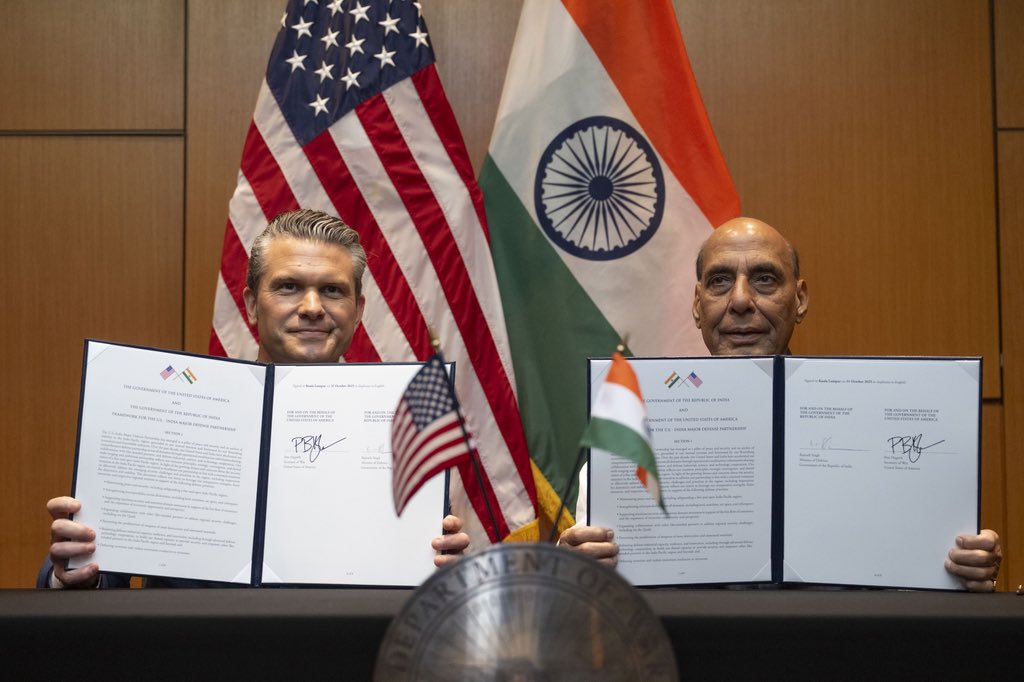
The United States and India have signed a 10-year defense cooperation framework aimed at expanding intelligence sharing, defense production, and high-technology collaboration. The agreement was formalized by U.S. Secretary of War Pete Hegseth and India’s Defense Minister Rajnath Singh on the sidelines of the ASEAN Defense Ministers’ Meeting in Kuala Lumpur, marking a new era in the Major Defense Partnership between the two countries.
The new Framework for the U.S.–India Major Defense Partnership (2025–2035) outlines a long-term plan to enhance military coordination across the Indo-Pacific, promote joint production in areas such as missiles, aircraft, and armored vehicles, and co-develop advanced systems using artificial intelligence and autonomous technologies. It also expands real-time intelligence and maritime domain sharing, reinforcing interoperability between the two nations’ armed forces.
Officials said the deal renews and expands previous pacts signed in 2005 and 2015, with a greater focus on modern warfare and emerging technologies. The framework builds on discussions held during Prime Minister Narendra Modi’s February 2025 visit to the White House, where he and President Donald Trump emphasized deeper industrial and strategic defense ties.
The new 10-year plan seeks to establish joint defense industrial ecosystems, strengthen supply chain resilience for critical technologies, and promote defense startup collaboration between the two nations. It also aims to enhance cooperation under the Indo-Pacific Command and deepen coordination through the Quad alliance alongside Japan and Australia.
Key features of the agreement include joint weapons production, AI-driven drone co-development, cyber and intelligence exchange, and expanded logistical access under the Logistics Exchange Memorandum of Agreement (LEMOA). The deal is expected to accelerate the co-production of precision munitions, air defense systems, and next-generation naval platforms while fostering joint cybersecurity operations.
The signing took place amid growing security tensions in the South China Sea and Taiwan Strait. Both leaders reaffirmed their commitment to maintaining peace, stability, and freedom of navigation in the Indo-Pacific region. Rajnath Singh said the agreement “reaffirms the depth of India’s defense engagement with the United States and strengthens our collective capacity to ensure peace and stability in the region.” Secretary Hegseth described the partnership as “a cornerstone of Indo-Pacific security that will define defense cooperation for the next decade.”
Analysts believe the agreement will boost India’s defense manufacturing ambitions under the ‘Make in India – Global Defense’ initiative, attract U.S. investment into defense corridors in Tamil Nadu and Uttar Pradesh, and expand technology transfers in areas such as cybersecurity, naval design, and aerospace innovation. It will also strengthen operational synergy between the two militaries, complementing joint exercises like Yudh Abhyas and Malabar.
The U.S.–India 10-Year Defense Framework (2025–2035) marks a major milestone in bilateral defense cooperation. By integrating technology, intelligence, and industrial capabilities, the agreement enhances deterrence across the Indo-Pacific and positions both nations as strategic partners committed to regional stability and collective security.